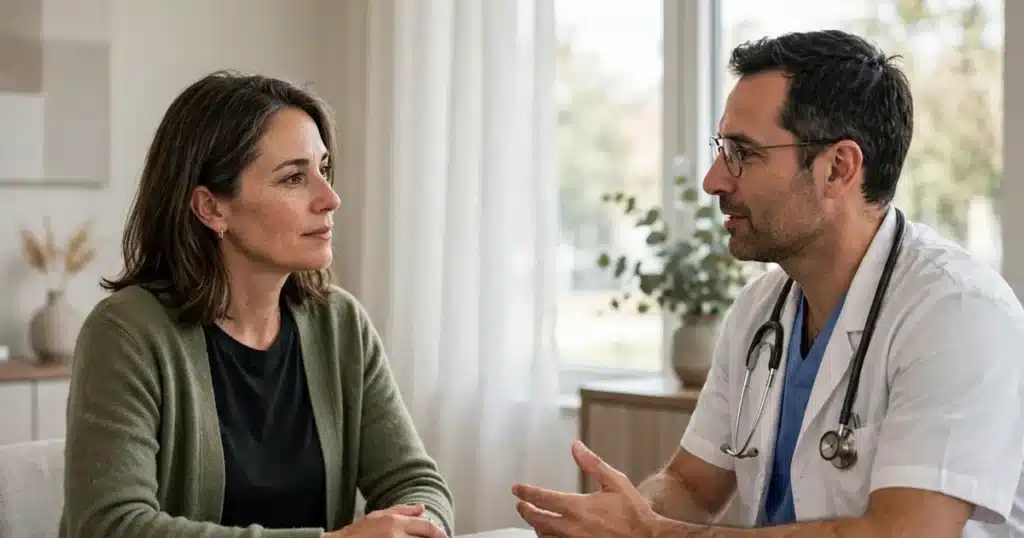
A prophylactic mastectomy — also called a risk-reducing mastectomy — is surgery that removes breast tissue from a breast in which no cancer has been found, with the aim of lowering the chance that breast cancer develops there in the future. “Prophylactic” simply means preventive. People usually consider it because their risk is higher than average, often because of an inherited gene change or a strong family pattern, and the decision is made together with a surgical team after unhurried discussion. It is elective surgery: chosen, not urgent, with time to think, ask questions, and seek another opinion.
Key Takeaways
- A risk-reducing mastectomy removes breast tissue before cancer is found in that breast, in order to lower future risk.
- It is most often discussed by people whose risk is higher than average — for example, an inherited gene change or a strong family pattern of breast cancer.
- The surgery lowers risk but does not reduce it to zero, because no operation can remove every trace of breast tissue.
- Closer monitoring with screening, and for some people medicines that lower risk, are other approaches a team may discuss instead of, or alongside, surgery.
- Reconstruction — with implants or your own tissue — or closing flat are choices to explore with the surgical team.
- There is no single right answer. It is a personal decision, and asking for a second opinion is a reasonable step.
What the Operation Is
A mastectomy is an operation that removes breast tissue. When it is done on a breast with no cancer in it, specifically to reduce future risk, it is called prophylactic or risk-reducing. It may involve one breast or both — removal of both is called a bilateral risk-reducing mastectomy. The term is also used for one part of a larger operation: when someone has cancer in one breast and chooses to have the other, unaffected breast removed as well, the preventive part of that surgery concerns the breast without cancer.
The surgeon removes as much breast tissue as is practical. Breast tissue, though, is spread through the breast area rather than packed into a neat shape, so no mastectomy can remove every single breast cell. That is why the honest description of this surgery is that it lowers risk considerably rather than ending it. Our pillar guide, How Breast Cancer Treatment Plans Are Made, explains how surgical decisions are weighed — the same careful, individual weighing applies here, even though this surgery is about prevention rather than treating a cancer that has been found.
Who May Consider Discussing It
This surgery is not part of routine care for average risk. It enters the conversation when a person’s risk is higher than average, in situations such as:
- An inherited gene change. Some people carry an inherited change in a gene linked to a higher chance of breast cancer — genes such as BRCA1 and BRCA2 are the best known. Testing can look for these changes, and a genetic counsellor can help you understand what a result would and would not mean before you decide anything.
- A strong family pattern. Several close relatives with breast cancer, cancers appearing at younger ages in the family, or certain combinations of cancers in relatives can lead a team to describe risk as raised.
- Certain earlier findings. Some non-cancerous biopsy results that show atypical (unusual-looking) cell changes are associated with higher future risk and prompt a wider discussion.
- Radiation to the chest earlier in life. Treatment involving radiation to the chest at a young age is another situation in which risk may be discussed as raised.
Belonging to one of these groups does not mean surgery is recommended. It means a conversation is worth having, in which your team sets out how they see your risk and all the ways it could be managed. Our guide to questions to ask your oncologist can help you prepare for that kind of discussion, whichever specialists lead it.
Comparing the Approaches to Higher Risk
Surgery is one of several approaches to managing higher risk, and it is not the only one on the table. In general terms:
| Approach | What it involves, in general | What it does not do |
|---|---|---|
| Risk-reducing mastectomy | A planned operation removing most breast tissue from one or both breasts | Does not remove every breast cell, so risk is lowered rather than ended |
| Closer monitoring | More frequent screening, which may combine mammograms with other imaging such as MRI scans | Does not lower the chance of cancer developing; its aim is to find any cancer early |
| Risk-lowering medicines | Medicines that act on hormones, discussed for some people at higher risk | Not suitable for everyone; benefits and side effects are weighed individually |
These approaches are not always either/or. Some people choose monitoring now and revisit surgery later; some combine approaches over time. A decision made at one point in life can be reconsidered as your situation, health, and feelings change — ask your team how they would structure that ongoing conversation.
Choices Around the Surgery Itself
If you lean toward surgery, there are further choices to work through with the surgical team. The type of mastectomy varies: a skin-sparing mastectomy keeps most of the breast skin, and a nipple-sparing mastectomy keeps the nipple as well; whether either is possible depends on your individual situation. After the tissue is removed, the chest can be reconstructed with implants or with your own tissue, at the same operation or a later one — or closed flat, an option described in our article on aesthetic flat closure. Each route has its own recovery and its own follow-up operations or appointments to consider.
Our article on preparing for mastectomy surgery day describes what a surgery day generally involves. Recovery from this surgery takes time and varies from person to person; your team will explain what to expect, what support you will need at home, and which follow-up appointments to plan for.

Living With the Decision
People feel many different things about this choice: relief at having acted, grief about what was given up, both at once, or something quieter. There is no correct emotion, and feelings can shift over the months after surgery. Body image, intimacy, and conversations with partners and family all form part of living with the decision, whichever way it goes. Support is available through cancer centres and support organisations even when no cancer has been found — you do not need a diagnosis to ask for it. What matters most is that the decision is made with full information, at your pace, and for your reasons.
Questions to Ask Your Doctor
- Based on my history, how would you describe my level of risk in general terms?
- What are all the approaches we could discuss — surgery, closer monitoring, medicines — and the trade-offs of each for me?
- If I chose surgery, would one breast or both be involved in my case?
- Which type of mastectomy, and which reconstruction or flat-closure options, would be open to me?
- What would recovery involve, and what support is available afterwards?
- If I decide against surgery for now, what monitoring would you recommend, and can I revisit the decision later?
- Can you refer me to a genetic counsellor, or help me arrange a second surgical opinion?
Frequently Asked Questions
Does a risk-reducing mastectomy remove all risk of breast cancer?
No. It lowers risk considerably, because most of the breast tissue is removed, but some tissue remains in the chest area after any mastectomy, so the risk is not zero. Your team will explain what follow-up, if any, they advise afterwards in your situation.
Is this surgery only for people with an inherited gene change?
No. An inherited gene change is the best-known reason the surgery is discussed, but a strong family pattern, certain earlier biopsy findings, or past radiation to the chest can also lead to the conversation. In every case the decision is individual, based on your own history and your team’s assessment.
Do I have to decide quickly?
In general, no. This is preventive, elective surgery, and there is usually time to gather information, talk with family, and seek a second opinion. If the surgery is being considered alongside treatment for a cancer that has been found, timing becomes part of that treatment discussion instead — ask your team to be clear about which situation applies to you.
Will I still need breast screening after the surgery?
That depends on the surgery you had and your individual situation, and it is a question to settle with your team rather than assume either way. Some follow-up usually continues, even if formal screening images are no longer part of it.
Can reconstruction be done at the same operation?
Often it can be discussed as part of the same operation, or planned for a later date, or not chosen at all in favour of a flat closure. Which routes are open to you depends on the type of mastectomy and your own circumstances, and your surgical team will set out the options honestly.
Related Articles
- How Breast Cancer Treatment Plans Are Made: A Complete Guide
- Nipple-Sparing Mastectomy Explained in Plain Language
- Skin-Sparing Mastectomy, Explained in Plain Language
- Aesthetic Flat Closure Explained
- Preparing for Mastectomy Surgery Day
This article is for general educational purposes only and is not medical, legal, or financial advice. It does not replace professional care. Talk to your doctor or care team about your own situation. If you think you may have a medical emergency, call 911.