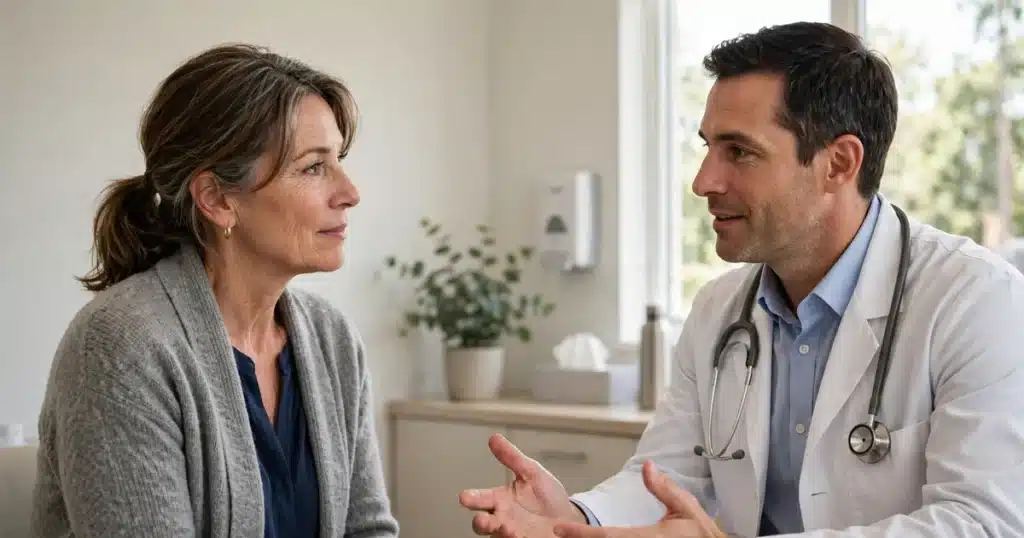
Myths about breast cancer travel fast because they sound simple, and simple answers are comforting when a subject is frightening. The careful position on the common claims is less dramatic: breast cancer can affect men as well as women, a lump is only one of several possible signs, checking your own breasts does not replace screening, and no food, supplement, or alternative therapy is a proven cure for breast cancer. This article takes a small set of well-known claims one at a time and sets beside each what reliable general sources actually say.
Key Takeaways
- Every claim in this article is framed as a claim — wording you may hear — followed by the careful general position. Nothing here presents a myth as a fact.
- Breast cancer is not only a women’s disease: men have breast tissue and can develop breast cancer, so a change in a man’s chest or breast area also deserves medical attention.
- A lump is one possible sign, not the only one. Skin changes, nipple changes, and other persistent changes are also reasons to see a doctor, and some breast cancers are found by screening before any sign can be felt.
- Knowing your own breasts and reporting changes is valuable — and it does not replace screening. The two work alongside each other.
- No food, supplement, or alternative therapy is proven to cure breast cancer. Anyone offered a cure outside medical care is being offered something unreliable, and delaying real treatment for it can be dangerous.
- For current general information, the reliable reference points are the American Cancer Society (cancer.org) and the National Cancer Institute (cancer.gov). Your own care team is the right judge of anything about your own situation.
How to Use This Article
Claims about breast cancer arrive from every direction — family sayings, social media, forwarded messages, well-meant advice from friends of friends. Our pillar guide to breast cancer awareness and resources places accurate information at the centre of awareness work, and this article is part of that: a short, careful checking of a handful of claims that reliable sources address consistently.
Two ground rules. First, this article states no statistics in either direction — not to support a claim and not to knock one down. Figures change and are easy to misuse; where numbers matter, current figures are published by the American Cancer Society (cancer.org) and the National Cancer Institute (cancer.gov). Second, where a claim touches your own body or your own treatment, the answer that counts is your own doctor’s. General information — including this article — is a starting point for a conversation, never a substitute for one.
The Claim: “Only Women Get Breast Cancer”
The careful position: this claim is not correct. Men have breast tissue too, and breast cancer does occur in men — far less often than in women, but really, and sometimes diagnosed late precisely because neither the man nor the people around him expected it. Our article on male breast cancer awareness is devoted to this point. The practical lesson is shared across sexes: a new lump or persistent change in the breast or chest area is worth medical attention whoever it happens to, and “it cannot be breast cancer because he is a man” is a claim that delays real diagnoses.
The Claim: “It Only Happens If It Runs in Your Family”
The careful position: family history matters, but it is not the whole story. Many people diagnosed with breast cancer have no close relative who had it, and having an affected relative does not mean a diagnosis is inevitable either. Family history is one thread in a larger picture, which is why awareness guidance is addressed to everyone rather than only to people with affected relatives — the same point made in our article on awareness for young women. If your family’s pattern concerns you, the constructive step is to record what you know and discuss it with your own doctor, who can judge what it may mean in your case.
The Claim: “A Lump Is the Only Sign to Watch For”
The careful position: a lump is one well-known sign, not the only one. Reliable general sources describe a wider set of changes that deserve attention, including changes in the skin of the breast, changes to the nipple, swelling, and other new and persistent differences from what is normal for you. Just as important is the other half of the picture: some breast cancers cause no sign that can be felt at all in their early stages and are found by screening images instead. Both halves point the same way — know what is normal for you, report any persistent change promptly, and do not let the absence of a lump talk you out of either screening or a check. Our awareness calendar shows how the year’s observances keep exactly these messages in circulation.

The Claim: “Checking Yourself Replaces Screening”
The careful position: knowing your own breasts and screening do different jobs, and one does not replace the other. Being familiar with how your breasts normally look and feel helps you notice and report a change between appointments. Screening exists because imaging can find some cancers before they can be felt at all. Guidance about screening — who it is for and how often — is set out by bodies such as the American Cancer Society and the National Cancer Institute and changes over time; this article states no schedule. Your own doctor can tell you what screening is appropriate for you, and a change you notice should be checked promptly rather than saved for a future screening appointment.
The Claim: “Something I Did — or Used — Caused Mine”
The careful position: in an individual case, doctors generally cannot point to a single cause, and the popular versions of this claim — blaming a product, a food, a habit, or a stressful period — go well beyond what is known. Research describes factors that shift risk across large groups of people; that is a different thing from a cause in one person’s life, and it is not a basis for blame. This matters beyond accuracy: the claim is often aimed at the diagnosed person herself, at the moment she is least able to carry it. If cause questions are weighing on you, general information is published at cancer.org and cancer.gov, and your own doctor can talk through what is and is not known in your situation.
The Claim: “There Is a Natural or Alternative Cure”
The careful position: this claim should be stated plainly. No food, supplement, or alternative therapy is a proven cure for breast cancer. Products and programmes are sometimes promoted with that promise — often with testimonials rather than evidence, and often at significant cost — and testimonials are not proof: this site publishes none, for anything, for that reason. The danger in the claim is not only the money. It is delay: time spent on an unproven cure is time in which a treatable cancer can grow. Supportive approaches that help you feel better — rest, gentle movement, good food, relaxation — have their place alongside medical care, and many people value them there. Alongside is the key word. Anything offered to you as a replacement for treatment, or with instructions to keep it secret from your care team, should be treated with deep suspicion, and anything you are taking or considering is worth mentioning to your team, since products can interact with treatment.
Checking Claims Yourself
| A claim deserves a pause when… | A steadier habit |
|---|---|
| It promises a cure, a certainty, or a secret “they” do not want you to know | Check it against cancer.org or cancer.gov before sharing or acting on it |
| Its only evidence is a person’s story, however moving | Remember a story cannot show what would have happened otherwise; look for the general evidence |
| It asks for money, quickly, for treatment outside medical care | Stop, and talk to your care team or a trusted organisation first |
| It contradicts your own care team | Ask your team about it directly — they would rather discuss a claim than discover you acted on it |
| It arrives as a forwarded message with no source | Find the claim on an official organisation’s website, or treat it as unverified — the spirit of our article on how awareness observances work, which separates genuine awareness from noise |
The comparison in our article on awareness versus action makes the companion point: reliable information earns its keep when it leads to a sensible action — a screening kept, a change reported, a doctor asked. A claim that leads only to fear, blame, or a purchase has told you something about itself.
Questions to Ask Your Doctor
- I have read a claim about breast cancer that worries me. Can I run it past you?
- Given my situation, what screening is appropriate for me, and what changes should I always report between appointments?
- Does my family history change anything about what I should watch for or ask about?
- I am considering a supplement or complementary approach. Is there anything about it I should know alongside my treatment?
- Where do you suggest I read about my type of breast cancer, so I am not relying on forwarded messages?
Frequently Asked Questions
Can men really get breast cancer?
Yes. Men have breast tissue, and breast cancer occurs in men as well as women. It is much less common in men, which is one reason it can be diagnosed late — a new lump or persistent change in a man’s breast or chest area deserves the same prompt medical attention as it would in a woman.
If there is no lump, can I stop worrying?
A lump is only one possible sign. Other persistent changes — in the skin, the nipple, the size or shape of the breast — are also reasons to see a doctor, and some cancers are found by screening before anything can be felt. Keep your screening arrangements, and report any persistent change rather than waiting for a lump.
I feel fine and check myself. Do I still need screening?
Checking yourself and screening do different jobs. Screening can find some cancers before they can be felt, which self-checking cannot do. What screening is right for you depends on your individual situation — ask your own doctor, and do not wait for a screening appointment to report a change you have noticed.
A product online says it can cure breast cancer naturally. Should I try it?
No food, supplement, or alternative therapy is proven to cure breast cancer. A cure claim — especially one sold with testimonials, secrecy, or urgency — is a warning sign, not a recommendation. Delaying medical treatment for an unproven product can allow a treatable cancer to grow. If something interests you, discuss it with your care team first.
How can I tell whether a breast cancer claim online is reliable?
Check whether the same position appears on an official source such as the American Cancer Society (cancer.org) or the National Cancer Institute (cancer.gov). Be wary of cure promises, single-story evidence, pressure to buy, and advice to hide anything from your care team. When in doubt, bring the claim to your doctor — it is a normal and welcome question.
Related Articles
- Breast Cancer Awareness and Resources: The Complete Guide
- Male Breast Cancer Awareness: Why Men Need to Know the Signs Too
- Breast Cancer Awareness for Young Women: Starting the Conversation Early
- Breast Cancer Awareness Days, Weeks, and Months: A Year-Round Calendar
- Awareness vs. Action: Turning October Pink Into Practical Help
- How Awareness Observances Work: Days, Weeks, Months, and Who Declares Them
This article is for general educational purposes only and is not medical, legal, or financial advice. It does not replace professional care. Talk to your doctor or care team about your own situation. If you think you may have a medical emergency, call 911.