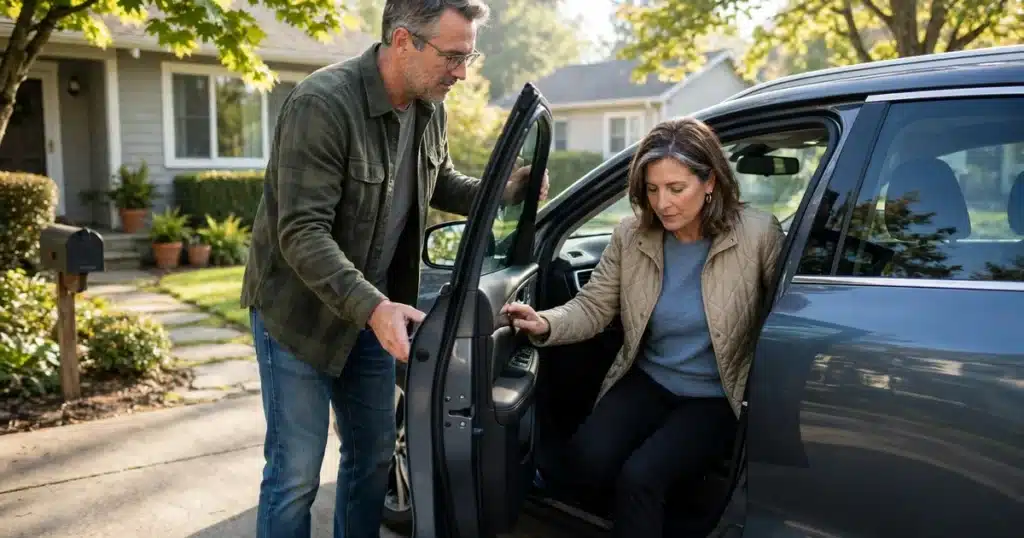
A backup ride plan is a simple arrangement, made in advance, for who will drive when the usual driver is ill, stuck at work, or dealing with an emergency of their own. It turns a stressful treatment-day scramble into one calm phone call to someone who has already agreed, and who already knows the address, the timing, and where to park. This article walks through building that plan — drivers, a one-page ride sheet, and what to do when no driver is available at all.
Key Takeaways
- A backup plan names at least one alternative driver — ideally two, in layers — who has genuinely agreed, in advance, rather than a hopeful assumption on the day.
- Every driver, main or backup, works better with the same written information: pickup time, the centre’s address and entrance, parking, and how long the day may run.
- A one-page ride sheet kept in one known place lets any driver step in without a long briefing.
- When no one can drive, options often still exist: your cancer centre’s social worker can describe community and volunteer transport locally, and the centre would rather help you rearrange than have you miss treatment quietly.
- Agree the plan while things are calm, and review it whenever appointments, drivers, or circumstances change.
Why a Backup Plan Matters
Most families settle into a driving routine with one main person, and it works — until the morning it does not. The main driver wakes up ill, a work meeting moves, a car will not start, or another family emergency lands on the same day as a long infusion. Treatment days are hard to improvise: arrival times matter, days can run long, and the patient is rarely in a position to solve the problem herself at short notice.
Our pillar breast cancer caregiver handbook treats transport as one of the core practical jobs of caregiving, and a backup plan is simply that job done properly: the same thinking that produces a main plan, extended one step further. Making the arrangement early has a second benefit — asking is far easier when it is hypothetical. “If I am ever stuck, could you be our backup driver?” is a relaxed conversation. The same question at 7 a.m. on a treatment day is a minor emergency.
Choosing Your Backup Drivers
Start with the people who have already offered help — the friends, neighbours, relatives, and community contacts who said “let me know if you need anything.” A specific, bounded job like driving is exactly what most of them were hoping to be asked for. Beyond that circle, consider people whose schedules have some flexibility, and people who live near either the patient’s home or the route to the centre.
- Ask directly, and make it easy to decline. A straightforward ask with a genuine “no is fine” produces reliable yeses. A reluctant driver is not a backup plan.
- Build layers, not a single name. One first backup and one second backup cover the realistic failures: illness, work, and their own family needs.
- Agree the scope. Is the backup happy to drive both ways and wait, or only to drop off? Would they stay for a long infusion day or prefer short appointments? Settling this in advance avoids mismatched expectations.
- Write down phone numbers. The patient, the main driver, and each backup should all hold everyone’s number, so a change can be coordinated by whoever spots it first.
Our guide to driving a loved one to cancer appointments covers the driving day itself — comfort, parking, and the journey home — and everything in it applies to a backup driver too, which is why the ride sheet below matters.

The One-Page Ride Sheet
The difference between a backup driver and a confident backup driver is information. A single page, kept in one known place and shared with every driver, removes the briefing problem entirely:
| On the sheet | Why it matters |
|---|---|
| Patient’s home address and pickup time | So the trip starts unhurried, with arrival time — not appointment time — in mind |
| Centre name, address, and the right entrance | Large hospitals have several entrances; the wrong one costs time and energy |
| Parking notes: which car park, payment method, drop-off point | The details the main driver learned the hard way, passed on instead of relearned |
| How long the appointment may run, and where drivers wait | Sets honest expectations for short reviews and long treatment days alike |
| Comfort notes: blanket, extra layer, seatbelt padding, quiet ride or conversation | Lets a substitute driver offer the same care as the usual one |
| Phone numbers: patient, main driver, backups, and the centre | So delays, overruns, and changes reach everyone who needs them |
Keep the sheet somewhere everyone can find it — a care binder, a shared phone note, a copy on the fridge — and update it whenever an appointment pattern changes. A backup driver who has read it once can step in with a single phone call, which is the entire point.
When No Driver Is Available
Sometimes there is no backup: family is far away, friends work the same hours, or the main driver is the only driver. That situation has its own options, and the place to map them is your cancer centre. Oncology social workers and patient navigators keep track of what exists locally — which can include volunteer driver schemes, community transport services, and nonprofit organisations that offer help with rides — and can tell you how each one works and how far ahead it needs booking. Our article on help with transportation to treatment walks through these kinds of options in more detail. Because schemes and eligibility vary by area and change over time, check current details with the service itself or through your centre rather than relying on anything second-hand.
And if a ride genuinely falls through at the last minute, call the treatment centre as early as you can. Teams would rather hear “our driver is ill, what should we do?” in the morning than discover a missed appointment afterwards. Sometimes the day can be rearranged, sometimes another solution exists — but only if the centre knows. Fitting rides into the wider rota of meals, errands, and visits is covered in our guide to coordinating practical help for a cancer patient, where backup driving sits naturally alongside the other shared jobs.

What to Do Next
- List the upcoming appointments that need a driver, with arrival times and likely lengths.
- Ask one person to be the first backup and another to be the second — directly, with a real option to say no.
- Write the one-page ride sheet and give a copy to the main driver and both backups.
- Swap phone numbers so the patient, main driver, and backups can all reach each other.
- Ask the cancer centre’s social worker what community or volunteer transport exists locally, and note the booking lead time on the ride sheet.
- After any appointment change, update the sheet the same day so the plan is never out of date.
Frequently Asked Questions
How many backup drivers do we need?
One genuine backup is a real improvement on none, and two layers — a first and a second backup — cover most of what life actually does to a plan. More than that is rarely necessary; what matters is that the people named have truly agreed and hold the ride sheet, rather than a long list of maybes.
What should a backup driver know about how long the day may be?
The honest picture: some appointments are short, treatment days can run long, and clinics sometimes overrun. Give the expected length and the realistic upper end, agree whether they will wait or return for pickup, and make sure they know the plan for food and their own time while waiting. People cope well with long days they were warned about.
Is it all right to ask a friend who offered to help “with anything”?
Yes — a specific driving request is usually a relief to someone who offered generally, because it is clear, bounded, and genuinely useful. Tell them the likely dates pattern, what the day involves, and that a no is completely fine. If they say yes, give them the ride sheet and treat them as part of the plan, not a last resort.
What if the backup driver also cancels on the day?
Go to the next layer if you have one. If no driver is available at all, phone the treatment centre as early as possible and explain — rearranging or problem-solving with you is a normal part of their day, and far better than a silent missed appointment. Afterwards, treat it as information: the plan needs another layer, not an apology.
Can a backup driver come into the appointment itself?
That depends on the centre’s arrangements and, most importantly, on what the patient wants. Some drivers simply drop off and collect; others wait and, if the patient wishes, come in as a second pair of ears. Agree it in advance for each kind of appointment, and let the patient change her mind on the day without it becoming an issue.
Related Articles
- The Breast Cancer Caregiver’s Handbook
- Driving to Appointments: A Caregiver’s Guide to Treatment-Day Transportation
- Help With Transportation to Breast Cancer Treatment
- Coordinating Practical Help for a Cancer Patient
This article is for general educational purposes only and is not medical, legal, or financial advice. It does not replace professional care. Talk to your doctor or care team about your own situation. If you think you may have a medical emergency, call 911.