
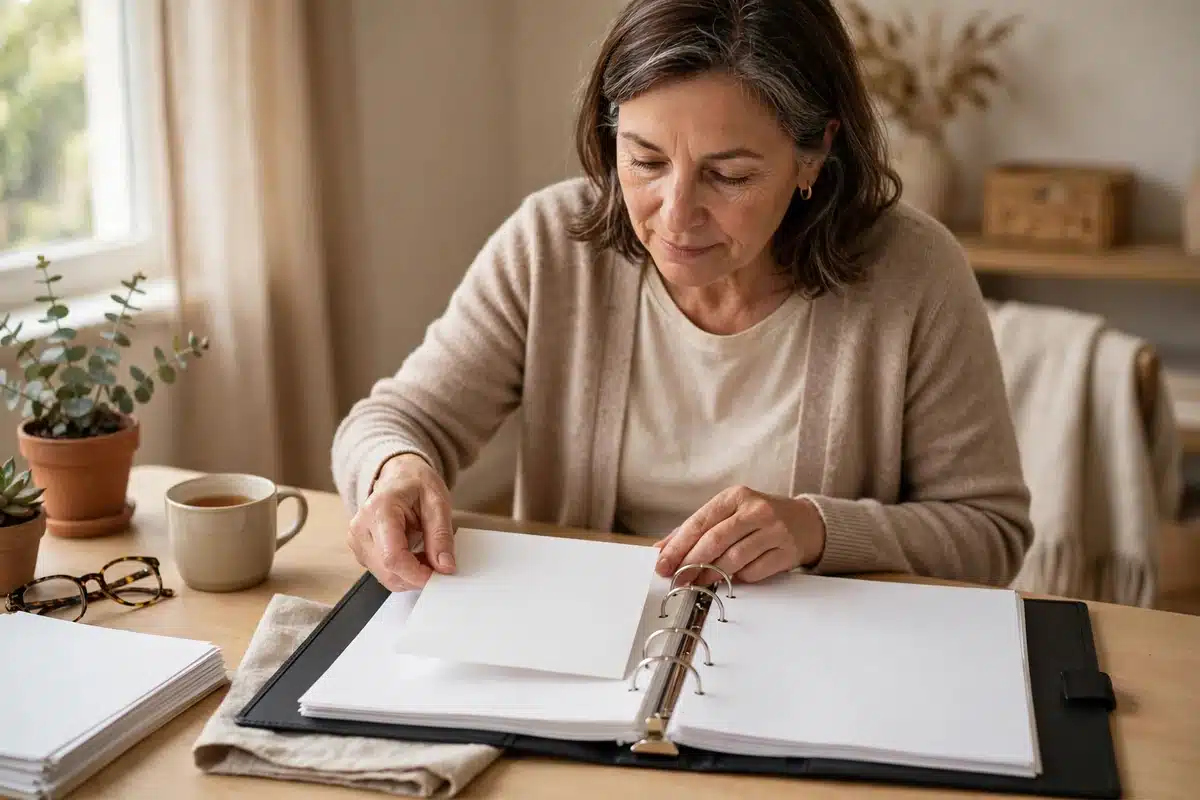
A care binder is one ordinary ring binder — or one folder system — that holds everything about her treatment in one place: contacts, appointment cards, test results, medicine lists, insurance letters, and your own notes. For a caregiver, it is the difference between hunting through piles and drawers in a stressful moment and opening one cover. You do not need a stationery project or a perfect system; you need a structure simple enough that you will actually keep it up on a tired Tuesday.
Key Takeaways
- The binder’s job is retrieval: any document, found in under a minute, by you or by anyone standing in for you.
- Five or six plain sections cover almost everything — contacts, appointments, results, medicines, insurance and money, and notes.
- Update it in the moment, not later: two minutes after each appointment or phone call keeps it trustworthy.
- Keep the one-page summary — diagnosis basics, current medicines, team contacts, allergies — at the very front; it is the page every new professional asks for.
- The binder belongs to the patient. Caregivers maintain it with her knowledge, and decide together who else may look inside.
Why a Binder Earns Its Place
Cancer care generates paper at remarkable speed, and it arrives at the worst times — results handed over while you are still absorbing them, insurance letters that matter but cannot be faced today. A binder gives all of it one home. Its real value shows in three moments: the phone call where someone asks for a date or a reference number; the new professional — a pharmacist, a covering doctor, a second-opinion clinic — who needs the story quickly; and the day you cannot be the one to go, when the binder lets someone else step in without a briefing. Our handbook for breast cancer caregivers places the binder among the practical systems that make the supporting role sustainable, and our visit-by-visit list of questions caregivers can ask assumes you have somewhere to write the answers down.
The Sections That Cover Almost Everything
Plain dividers, labelled in your own words. This arrangement works for most families:
| Section | What goes in it | Why it earns its tab |
|---|---|---|
| Summary page (front) | Diagnosis in a line or two, current treatment, medicine list, allergies, team names and phone numbers, emergency contact | The single page you photocopy, photograph, or read aloud whenever anyone new asks “so, what’s the situation?” |
| Appointments | Appointment cards and letters, a running list of past and future dates, travel notes | Answering “when was the last scan?” and “what is next?” without guessing |
| Results and reports | Pathology reports, scan and imaging reports, blood test printouts, letters from specialists | The documents other doctors ask to see — and the ones a records transfer will request |
| Medicines | A current medicine list with doses as written on the labels, plus a note of anything stopped and when | Every clinician asks; an accurate, dated list prevents errors and duplicated questions |
| Insurance and money | Insurance cards (copies), approval and denial letters, bills, receipts, reference numbers from phone calls | Claims and appeals are document contests — this section is your evidence drawer |
| Notes | Your appointment notes, questions waiting to be asked, symptom notes with dates | Memory under stress is unreliable; the written note is the version you can trust |
If she keeps advance paperwork — copies of legal or planning documents she has completed — a final section can hold copies. Questions about preparing or completing such documents belong to an attorney or notary familiar with your state’s rules; the binder only stores the copies safely.
Setting It Up, Step by Step
- Start with what already exists. Gather the current pile — letters, cards, printouts — before buying anything. One sorting session on a table, into the six piles above, is most of the work.
- Build the summary page first. One page, handwritten is fine: name, date of birth, diagnosis in plain words, current treatment, medicines, allergies, the care team’s names and numbers, and your own contact details as caregiver.
- File newest at the front of each section. Then the document you reach for is always the first one, and older papers settle behind it in order.
- Date everything. A note without a date loses half its value within a month. Write dates on anything you add, including printouts that arrive undated.
- Add a questions page at the front of Notes. Every stray “must remember to ask” goes there the moment it occurs to you — see our system for taking notes at oncology appointments for how to use it in the room.
Keeping It Current Without It Becoming a Chore
Binders fail by backlog, not by design. The habits that prevent it are small: file the letter the day it arrives, before it joins a pile; spend two minutes after each appointment updating the summary page and medicine list while the changes are fresh; and once in a while — at a treatment change or a new phase — thin out duplicates and superseded appointment cards so the binder stays liftable. A phone photo of new documents, kept in one album, makes a serviceable backup if the binder is ever lost, and a travelling copy of the summary page in your bag or car covers the unexpected trip. Our survivorship companion on keeping medical records organised after treatment covers the longer-term archive the binder eventually becomes.

Using It at Appointments and at Home
Take the binder to every appointment. It answers the intake questions, holds the day’s new papers, and gives your notes a home before they can scatter. At home, it has a fixed place — one shelf, one drawer — known to both of you, so a document can be found by whoever is asked first. Two cautions keep it kind as well as useful. It is her record before it is your system: she decides who sees it, and sensitive letters are not family reading without her say-so. And the binder is a tool, not a test — a week where nothing got filed is a week to forgive, not a failure to confess. The goal is a system that lowers the temperature of the hard moments, maintained by a caregiver who is also allowed to be a person.
Questions to Ask the Care Team
- Can we have a printed copy of today’s results and letters for our records?
- Is there a one-page treatment summary you can give us for the front of our file?
- Who should be on our contact list for out-of-hours questions?
- If another doctor needs the records, what is the quickest way to request them?
- Are there patient-portal printouts you recommend we keep?
Frequently Asked Questions
Paper binder or digital files — which is better?
Whichever you will actually maintain. Paper is easy to hand across a desk and works in a power cut; digital files are searchable and easy to share with the care team. Many families run a light version of both: the binder for appointments and originals, a phone album or folder of photos and PDFs as the backup.
What if we are starting late, months into treatment?
Start from today. File what you have, build the summary page from current information, and let the older paperwork join gradually if it surfaces. A binder that covers the present and future well is far more useful than a perfect archive nobody finishes.
Should the binder hold originals or copies?
Copies are fine for almost everything, and originals of anything irreplaceable are safer kept at home. What matters is that the information is findable, not that the paper is the first printing.
Who else should know the binder exists?
Anyone who might step into the caregiver role — an adult child, a sibling, a close friend. The binder’s quiet superpower is that it briefs a substitute without you in the room. Tell them where it lives; the contents can stay private until needed.
What do we do with the binder when treatment ends?
Keep it. It becomes the core of her long-term health record — the file future doctors will ask about for years. The survivorship guide to organising records after cancer explains how to slim it into an archive once the appointment pace slows.
Related Articles
- Breast Cancer Caregiver Handbook: A Complete Guide
- Taking Notes at Oncology Appointments: A Caregiver’s System That Works
- Keeping Your Medical Records Organized After Breast Cancer
- Questions Caregivers Can Ask the Oncology Team: A Visit-by-Visit List
- Caregiver Guide: Helping a Loved One Through Treatment
This article is for general educational purposes only and is not medical, legal, or financial advice. It does not replace professional care. Talk to your doctor or care team about your own situation. If you think you may have a medical emergency, call 911.