If there is no cancer center near you, you still have real options: many people’s care is deliberately organised across distance, with specialists at a regional center planning treatment that local doctors deliver, video appointments filling the gaps, and records and imaging moving between teams. Distance changes the logistics of care, not its quality — but it does reward planning. This article sets out the main models of long-distance care, the practical questions to ask, and where help with travel and lodging usually comes from.
Key Takeaways
- Care far from a center is common and planned-for: regional centers routinely coordinate with local hospitals and doctors.
- The most common pattern is shared care — specialists design the plan and review progress, while treatment and routine appointments happen closer to home where the team judges it safe.
- Video and phone appointments, remote second opinions, and digital record-sharing remove many journeys, though not every step can be done from a distance.
- Travel and lodging help exists through hospital social workers and nonprofit organisations, in general terms — eligibility varies, so verify on official websites and ask early.
- The anchor is communication: named contacts at both ends, records that actually arrive, and one clear answer to “who do I call first?”
Distance Is Common — and Planned For
Specialist cancer care is concentrated in cities; patients are not. Regional cancer centers serve wide areas, and their teams are used to patients who live hours away — the referral patterns, the shared-care arrangements, and the video follow-ups described here are ordinary practice, not special favours. What distance genuinely changes is the cost of poor coordination: a missing report or an unshared scan means another long trip, not a walk down the corridor. So the patients who fare best at a distance are the ones who treat organisation as part of treatment. Our pillar guide to navigating breast cancer care maps the system you are working within, and our article on how to find a breast cancer specialist covers choosing where the specialist end of your care should sit.
The Main Ways Distant Care Is Organised
| Model | How it works, in general | What to ask |
|---|---|---|
| Regional center for the big steps | Diagnosis, planning, surgery, and major reviews at the center; you travel for the milestones | “Which steps must happen here, and which can happen nearer home?” |
| Shared care | The center designs the plan; a local oncologist or hospital delivers appropriate parts and reports back | “Who leads my care day to day, and how do the two teams communicate?” |
| Local care with specialist oversight | A local team treats you, with the center reviewing your case — sometimes through formal case conferences — at key points | “Will my case be reviewed by the center’s team, and at which decision points?” |
| Video and phone appointments | Consultations, results discussions, and follow-ups held remotely where the team offers them and the appointment suits it | “Which of my appointments can be video or phone, and what do I need for them?” |
| Remote second opinion | Your records and imaging are sent to specialists elsewhere for an independent view, sometimes without you travelling at all | “Can my records be sent for a second opinion, and what does that process need from me?” |
These models combine. A typical pattern is a center-led plan, locally delivered treatment, video check-ins between, and travel reserved for scans, surgery, and turning points. What is safe to deliver locally depends on the treatment itself and the facilities nearby — that judgement belongs to the teams involved, and it is a reasonable thing to ask them to explain. Our guide to switching cancer centers during treatment covers the related situation where the distant option becomes your main center mid-course.
Records, Imaging, and Staying Connected
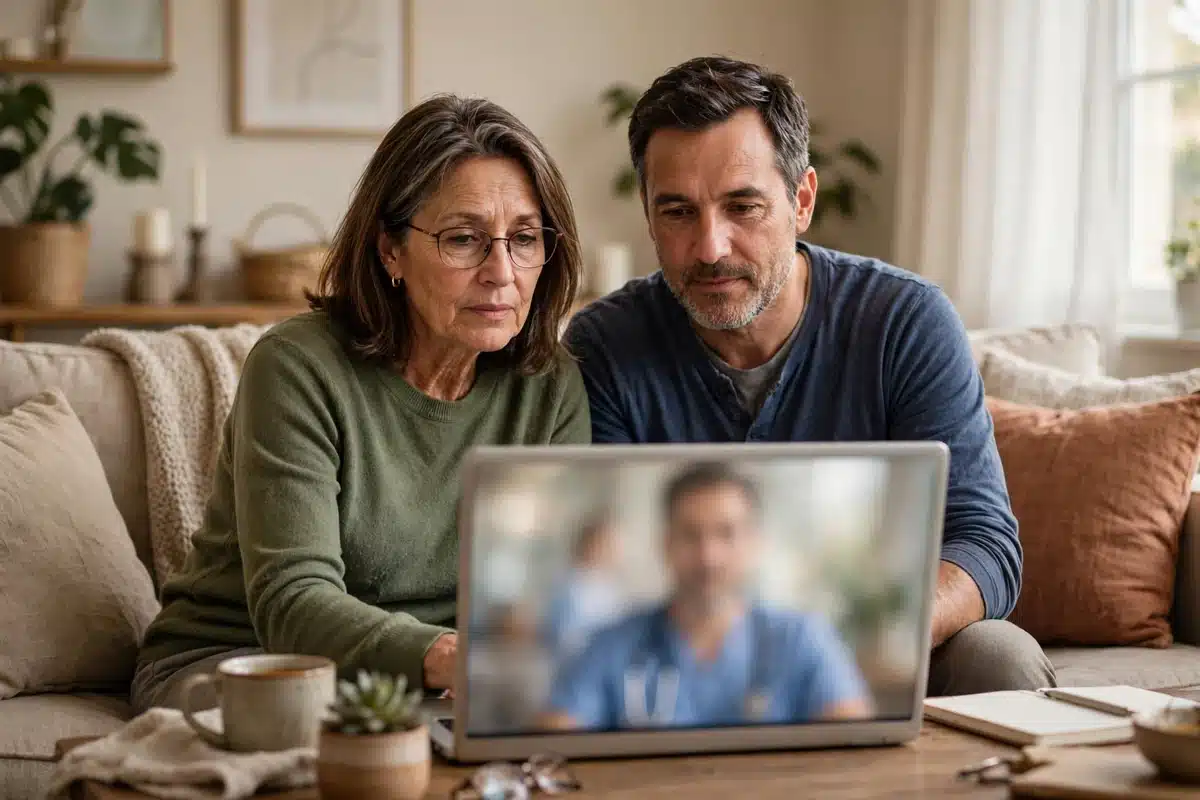
Distance makes you the most reliable courier in the system. Keep your own file — pathology and imaging reports, treatment summaries, a current medicine list — and bring it, physically or digitally, to every appointment at either end. Ask each team how they share records with the other and confirm that imaging, not just reports, can be transferred; a scan image reviewed at the center is worth more than a paragraph describing it. Know the named contacts: a nurse navigator, coordinator, or a specific phone number at the center, and the equivalent locally. When something changes — a new symptom, a rescheduled treatment — one call to the right contact prevents the two teams working from different versions of your care. Our guide to keeping your medical records organised sets out a filing system equal to this, and our explainer on how referrals work describes the paperwork that connects the teams in the first place.

Travel, Lodging, and Practical Help
Travel is a real cost of distant care, and help with it exists — though it is fragmented, and asking early matters more than asking widely. In general terms: hospital social workers and patient navigators are the first port of call, because they know the local schemes — hospital-arranged lodging, volunteer driver programmes, and discounted accommodation near the center. Nonprofit cancer organisations also run or fund travel and lodging support in various forms; what exists, and who qualifies, varies by organisation and place, so verify details on the organisation’s official website before relying on them. Your health plan may have provisions worth asking about, and your local team may know community resources — churches, civic groups, local charities — that never appear in national directories. None of this help finds you automatically. Say, plainly and early, “travel is hard for us” — it is information the system can act on, and the first visit to the center is the right moment to say it.
Questions to Ask Both Teams
- Which parts of my care must happen at the center, and which can safely happen closer to home?
- Who is my named contact at each end, and who do I call first if something changes?
- How will records and scan images move between you — and should I carry copies myself?
- Which appointments can be done by video or phone?
- If I need urgent help between visits, what is the plan — local hospital, or call the center first?
- What travel or lodging help do patients from my area usually use?
Frequently Asked Questions
Will care be worse because I don’t live near a center?
Not inherently. The models in this article exist because distance is normal, and outcomes rest on the plan and the communication around it, not on your postcode. The genuine risks are logistical — records that do not travel, appointments misunderstood — and those are the risks good organisation closes down.
Can I have all my treatment locally and just consult the center?
Sometimes that shared pattern is possible, and sometimes specific treatments need the center’s facilities or teams. It depends on your treatment and on what your local hospital offers. Ask both teams to map it out for your case — the conversation is a standard one.
Are video appointments really offered for cancer care?
Many centers offer them for suitable appointments — consultations, reviews, results discussions — though procedures, scans, and examinations still need you in the room. Availability and rules vary by center, state, and insurer, so ask your team which of your appointments qualify.
What if something urgent happens and the center is hours away?
Agree the answer before you need it. For a true emergency, your nearest emergency care is the right destination; for urgent-but-not-emergency worries, most teams give patients a contact route and instructions. Get both written down, and make sure your local hospital knows your situation and can reach your center team.
Can I change my mind and move my care to the center later?
Yes — changing where care is based, in either direction, is a recognised step rather than a commitment you are locked into. Our guide to switching cancer centers during treatment walks through how a planned changeover works.
Related Articles
- Navigating Breast Cancer Care: The Complete Guide
- Switching Cancer Centers During Treatment: What to Plan For
- How to Find a Breast Cancer Specialist
- Your First Visit to a Cancer Center: What to Expect, Step by Step
- How Referrals to Specialists Work in Cancer Care
- Keeping Your Medical Records Organized After Breast Cancer
This article is for general educational purposes only and is not medical, legal, or financial advice. It does not replace professional care. Talk to your doctor or care team about your own situation. If you think you may have a medical emergency, call 911.