
Head scarves, turbans, hats, and soft sleep caps are the practical alternatives — or companions — to a wig during chemotherapy. The kind choices are soft, breathable fabrics with smooth seams, worn over a scalp that may be tender and more sensitive than usual. Beyond comfort, a covering does real work: it keeps your head warm, protects sensitive skin from sun and friction, and gives you back a measure of privacy and choice about how you present yourself.
Key Takeaways
- Scalp skin is often tender during chemotherapy, so soft, smooth, breathable fabrics — cotton, bamboo, soft jersey — are usually the most comfortable.
- Scarves offer the most variety and adjustability; pre-tied turbans and caps offer the most ease, especially on low-energy days.
- A liner or soft cap underneath adds comfort, stops slipping, and protects the covering from oils and products.
- Coverings also have practical jobs: warmth (a bare head loses heat quickly), sun protection, and cushioning against bumps and friction.
- You do not have to cover your head at all. Coverings are a comfort and a choice, never an obligation.
- Some hospitals and nonprofit organisations offer coverings, workshops, or vouchers — ask your care team what exists locally, and verify details on the organisation’s official website.
Why People Cover — and Why You Don’t Have To
People cover their heads during chemotherapy for ordinary, practical reasons as much as appearance. A scalp that has lost its hair is exposed: it gets cold, especially at night and in air-conditioned rooms; it sunburns easily; and it can feel sore or prickly as hair comes out and, later, as it regrows. A soft covering is simply a layer of protection. For many people there is also a social comfort in it — the choice of when to be visibly a patient and when to just be a person in a nice scarf.
None of that makes covering compulsory. Some people prefer a wig (our guides to choosing a wig and caring for a wig cover that route), some alternate between wig and scarf depending on the day, and some go bare-headed throughout. Our pillar guide to living through breast cancer treatment places these everyday decisions in context, and our overview of hair loss during chemotherapy explains the pattern coverings are helping you through.
The Main Options, Compared
| Option | What it is | Often chosen for |
|---|---|---|
| Head scarf | A square or oblong of fabric you tie yourself, in endless fabrics and prints | Variety, adjustability, dressing up or down; the most personal option |
| Pre-tied turban or cap | A ready-made soft cap, sometimes with gathered fabric styled like a turban | Ease — nothing to tie; good on tired days and for sleeping-adjacent rest |
| Hats with soft linings | Bucket hats, beanies, caps, and sun hats made or lined for sensitive scalps | Going outdoors; sun protection; blending in |
| Sleep cap | A very soft, light cap worn in bed | Warmth at night and protecting bedding from shedding hair |
| Liner or under-cap | A thin, smooth cap worn beneath a scarf, hat, or wig | Comfort, grip (stops slipping), and keeping outer layers cleaner |
Most people end up with a small rotation: a sleep cap, an easy pre-tied cap for home, and one or two scarves or hats for going out. That covers nearly every situation without a large wardrobe or a large spend — coverings range widely in price, and the simplest soft caps are generally among the least expensive options.
Fabrics, Seams, and Fit
Fabric choice matters more than style. Cotton and bamboo are soft, breathable, and absorb perspiration; soft jersey stretches gently and stays put; silk and satin feel smooth and cool but slide easily, so they work better as an outer layer over a cotton liner. Avoid anything scratchy against bare skin, and check seams: seams that sit flat, or coverings made without internal seams, spare a tender scalp a surprising amount of irritation. If parts of your scalp are sore, our guide to skin care during chemotherapy covers gentle care for treatment-sensitive skin more broadly.
Fit is the other half of comfort. A covering should feel secure without pressure — a band that is too tight can cause headaches and rub sore spots, and a loose scarf that keeps slipping is its own annoyance. Volume pads and soft inserts exist for people who want a more filled-out shape. If tying is hard because of arm or shoulder soreness after surgery, pre-tied styles and hats remove the problem entirely.
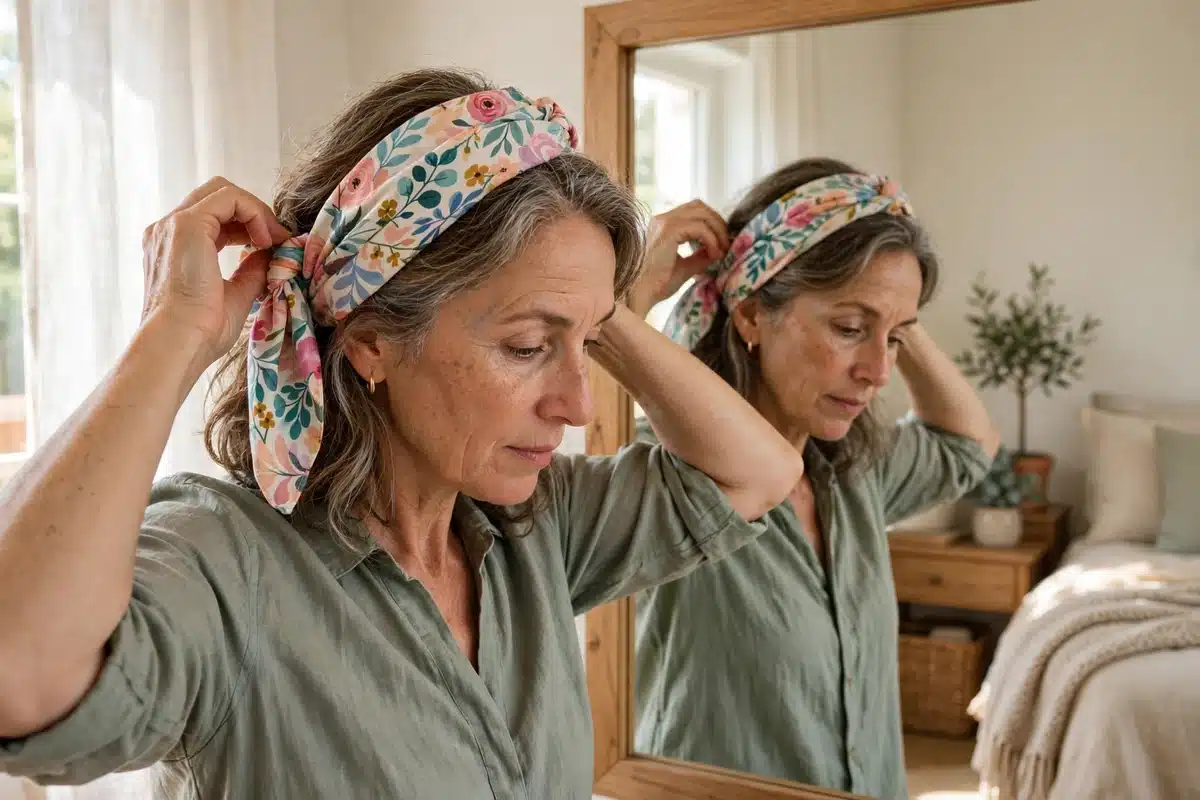
Tying a Basic Scarf, Step by Step
- Choose a scarf large enough to cover your head fully — a generous square or a long oblong both work.
- Fold it into a triangle (for a square) or fold a long edge down (for an oblong).
- Place the folded edge across your forehead or hairline, with the point or ends hanging at the back.
- Bring the two side ends around to the back and cross or knot them over the point.
- Tuck the point (or loose fabric) in, or bring the ends back to the front or side and tie a soft bow or knot.
- Adjust so it feels even and secure, and check in a mirror — then forget about it.
Practice once at home when you are unhurried, ideally before you need to do it on a schedule. Like most knots, it takes two or three tries to become automatic. A non-slip liner underneath makes every style easier, and slightly textured fabrics (cotton rather than satin) grip better for beginners.

Caring for Coverings and Your Scalp
Coverings sit against skin all day, so wash them regularly, following the fabric’s instructions, in a mild detergent, and let them dry fully. Rotating two or three makes this easy. Your scalp itself needs only gentle care: wash with a mild shampoo or cleanser as your team advises, moisturise dry skin with a plain, fragrance-free product if it helps, and protect a bare or thinly covered head outdoors with sunscreen or a hat — scalp burns are common and unpleasant. Some people also look at scalp cooling earlier in treatment; coverings remain useful alongside or after it.
Report anything that is more than ordinary sensitivity to your care team — a rash that spreads, broken or weeping skin, or soreness that worsens rather than settles. That advice also applies to reactions you suspect come from a fabric or detergent: switch to the plainest option you have and mention it at your next contact if it does not clear.
What to Do Next
- Before hair loss begins, if you can, try on a few styles and buy one sleep cap and one easy daytime covering.
- Choose soft, breathable fabrics with flat seams, and add a liner if slipping or itching is a problem.
- Ask your care team or hospital social worker what is available locally — some hospitals and nonprofit organisations provide coverings, tying workshops, or vouchers; verify details on the organisation’s official website.
- Practice your scarf tie at home once or twice, unhurried.
- Build a small rotation so washing and wearing never collide.
- Remember the covering is for your comfort — wear one when it helps, skip it when it doesn’t.
Frequently Asked Questions
What is the most comfortable fabric for a sensitive scalp?
For most people it is something soft, smooth, and breathable — cotton, bamboo, or a soft jersey — with flat seams or no seams. What irritates one person may suit another, so if the first fabric bothers you, trying a different one is a reasonable next step rather than giving up on coverings.
How do I stop a scarf from slipping off?
Slipping usually has one of three fixes: a slightly more textured fabric that grips (cotton over satin), a thin liner or under-cap worn beneath, or a tie that sits lower at the back of the head. Pre-tied caps solve the problem completely and are a good fallback on days when tying defeats you.
Should I wear a covering to sleep?
Many people do — a soft sleep cap keeps the head warm, which is the main reason people wake uncomfortable, and it catches shedding hair. It is a comfort choice, not a medical requirement; if you sleep comfortably without one, that is fine too.
Can I wear a hat over a wig, or a scarf under one?
Combinations are common and practical. A thin liner under a wig protects both your scalp and the wig, and many hats can be worn over wigs or over scarves. Whatever layering you use, keep total pressure gentle and take breaks if your scalp feels sore.
Are there coverings designed for hot weather?
Yes — lightweight cotton and bamboo caps and wide-brimmed hats are made for exactly that, and breathability matters more than coverage thickness in summer. A light covering plus sunscreen on exposed skin handles most hot days comfortably.
Related Articles
- Living Through Breast Cancer Treatment: A Practical Day-to-Day Guide
- Hair Loss During Chemotherapy: What to Expect
- Choosing a Wig During Chemotherapy
- How to Care for a Wig: Washing, Storing, and Making It Last
- Scalp Cooling and Cold Caps During Chemotherapy
- Skin Care During Chemotherapy: A Gentle Routine
This article is for general educational purposes only and is not medical, legal, or financial advice. It does not replace professional care. Talk to your doctor or care team about your own situation. If you think you may have a medical emergency, call 911.