
Long drives to a cancer center go better with a plan made the day before, not the morning of. The essentials are simple: know your route and your timing, build in unhurried comfort stops, pack the car for comfort rather than just for the appointment, and share the driving where you can. Whether a particular journey is right for the patient on a particular day is always a question for her care team — this article covers the practical planning around it.
Key Takeaways
- Plan the journey the day before: route, departure time with generous slack, where you will stop, and what happens if traffic or weather slows you down.
- Build in comfort stops on a schedule rather than waiting for discomfort — stretching legs, water, a short walk, and a change of air help most passengers.
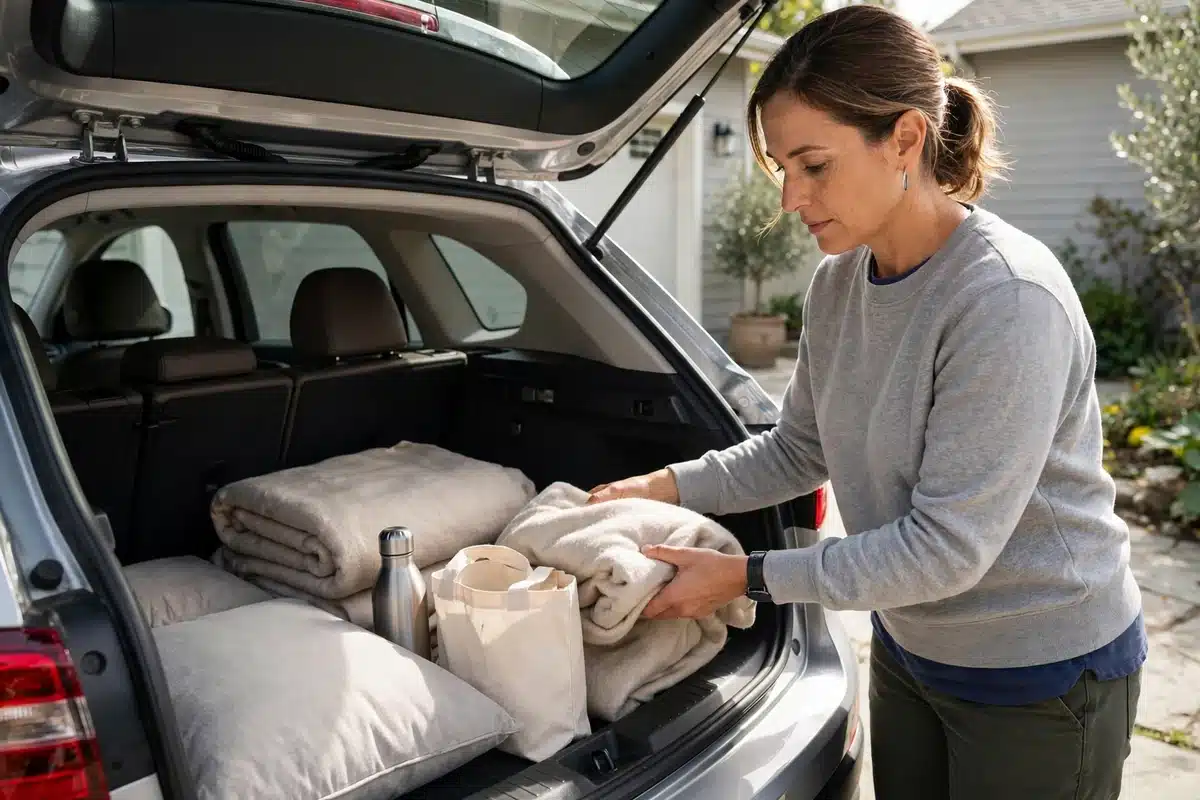
- Pack for the passenger: cushion, blanket, water, snacks she fancies, sickness supplies just in case, and something gentle to listen to.
- Share the driving where possible, and think through the journey home separately — treatment days are long, and the driver is often tired too.
- For very long trips, consider an overnight stay near the center or ask the center what travel and lodging support exists; arrangements vary.
- Any question about whether the patient should travel, drive herself, or how she will feel after a session belongs to her care team, not to this article.
Why Long Drives Need Their Own Plan
For many families, treatment does not happen around the corner. It happens at a regional center an hour or more away, and the journey becomes part of the treatment day itself — the early start, the motorway, the car park, and then the same road home when everyone is tired. Our pillar breast cancer caregiver handbook describes the caregiver’s whole role; this article is about one demanding corner of it, the long-distance trip, which our article on care options when you live far from a cancer center also touches from the patient’s side.
A planned journey removes decisions from the hardest moments. Nobody thinks well about routes at 6 a.m. or about food when the passenger feels queasy. Decisions made calmly the day before — where to stop, what is in the bag, who drives home — carry the day by themselves. The aim is not a perfect trip; it is a trip with nothing left to improvise.
Plan the Journey the Day Before
- Fix the departure time — then move it earlier. Work backwards from the appointment time, add the drive at its slowest realistic pace, add parking and walking-in time, and then add a buffer. Arriving early and resting beats arriving flustered, every time.
- Choose the route for calm, not just speed. A slightly longer route on easier roads may serve a tired passenger better than the fastest route through heavy traffic. Decide in advance so there is no debate at junctions.
- Scout the stops. Know roughly where you can stop for fuel, toilets, and a stretch — services, a supermarket, a country town. On an unfamiliar route, check before you set off.
- Check the practical details. Fuel or charge, parking arrangements at the center, whether the appointment letter asks you to bring anything, and the center’s number saved in your phone in case you are running late.
- Have a delay plan. If traffic or weather turns bad, the plan is: stop safely, phone the center, and let them advise. Centers that serve distant patients deal with delayed arrivals regularly; a phone call is always better than a frantic drive.
What to Pack for the Passenger
| Category | Useful things to have in the car |
|---|---|
| Comfort | A cushion or small pillow, a soft blanket, a neck pillow for resting, layers she can add or remove |
| Food and drink | Water, a flask of something warm if she likes it, plain snacks and a couple of things she genuinely fancies, mints or ginger sweets if she finds them settling |
| Just in case | A bag and tissues for sickness, wipes, a change of top, any supplies her care team has suggested she carry |
| Passing the time | Music, an audiobook or podcast downloaded in advance, a magazine — chosen for low effort, since concentration is often limited |
| The appointment itself | Appointment letter, her notebook of questions, a pen, phone charger, and anything the center asked her to bring |
Keep the kit in the car or in one bag that lives by the door, restocked after each trip, so packing becomes a two-minute check rather than a fresh task. Our guide to coordinating practical help shows how a simple standing kit like this fits into the family’s wider system of rotas and backup people.
Comfort Stops: The Heart of the Plan
On a long drive, stops are not lost time — they are the part that makes the rest bearable. Plan them rather than waiting for a crisis of stiffness or nausea:
- Stop on a rough schedule. Many passengers do best with a short stop every hour or so. Treat it as the plan from the start, not as falling behind.
- Use stops fully. Legs stretched, a few minutes of walking, water, the toilet, fresh air. Five unhurried minutes restore more than a rushed two.
- Let the passenger set the pace. Some days she will want to push on; other days she will need every stop going. The plan bends to the day, not the other way round.
- Watch the return trip. After treatment or a long appointment, she may be more tired, more sensitive to motion, or keen simply to get home. Ask, rather than assuming the outbound rhythm still fits. What a treatment day itself involves is covered in our article on coordinating care between a local doctor and a cancer center, which explains why so much care sits far from home in the first place.

Sharing the Driving and the Journey Home
A long treatment day is tiring for the driver as well as the patient — emotionally as much as physically. Waiting rooms, difficult conversations, and worry use up the same energy as the miles. Where you can:
- Rotate drivers across trips. A second insured driver — a family member, a friend — who takes some trips entirely gives the main caregiver recovery time. Our article on organising shared help such as a meal train shows the same rota principle applied to food; it works just as well for driving.
- Split the day. One person drives there, another drives home, if two of you travel — the homeward driver stays fresher for the leg that matters most.
- Be honest about tiredness. A driver who is exhausted is a risk, not a hero. Stopping for a proper rest, or swapping, is always the right call.
- Never assume the patient will drive. Whether she may drive herself — at all, or on treatment days — is a question for her care team, who know her treatment and its effects. Ask them directly and follow their answer.
Very Long Trips and Overnight Thinking
When the center is several hours away, the day return may simply be too much, and it is worth thinking about the alternatives calmly, in advance:
- An overnight stay near the center the night before an early appointment removes the dawn drive entirely, and staying over after a very long day can be safer than the drive home. Some centers can tell you about nearby options or hospital-linked lodging; what exists varies, so ask.
- Ask about travel support. Centers and organisations sometimes have schemes, funds, or volunteer driver programmes for patients travelling long distances. Eligibility and what is offered vary widely — ask the center, and check any organisation’s official website for current details before relying on them.
- Ask what can be done closer to home. Some appointments, tests, or follow-ups can sometimes be handled locally or remotely, with the center overseeing them — the pattern described in our guide to options when there is no cancer center near you. It is always reasonable to ask which trips are truly necessary.
- Weather thinking. In bad seasons, build the decision in advance: the threshold at which you phone the center, stay over, or set off much earlier — decided at the kitchen table, not at a snowy junction.
Individual situations differ greatly — distance, treatment pattern, the patient’s health, and your family’s resources all shape what makes sense. If the journeys are becoming unsustainable, raise that plainly with the care team; travel burden is a legitimate care problem, and teams that serve wide areas hear it often.
What to Do Next
- Before the next trip, write down the route, the departure time with buffer, and two planned stops.
- Assemble the standing car kit — comfort, food and drink, just-in-case supplies, entertainment, appointment papers — and keep it restocked.
- Save the center’s number in the driver’s phone, with a delay plan agreed: stop safely, phone, take their advice.
- Ask the care team the driving questions: may she drive herself, and is there anything about journey length they want you to observe?
- Line up a backup driver for some trips, and ask the center what travel or lodging support exists for distant patients.
- After each trip, note what helped — the best stop, the best snack, the worst junction — and adjust the standing plan.
Frequently Asked Questions
How early should we leave?
Earlier than feels necessary. Work backwards from the appointment: slowest realistic driving time, plus parking and walking in, plus a generous buffer. Arriving early costs you a rest in the car park; arriving late costs stress for everyone and sometimes the appointment itself. If you are delayed anyway, phone the center — they would far rather know.
How often should we stop?
There is no rule that fits everyone. Many passengers manage long drives best with a short stop roughly every hour — to stretch, walk a little, drink water, and use the toilet. Let the passenger’s comfort lead: on a good day she may want fewer stops; on a hard day, every stop going.
Can the patient drive herself to appointments?
That is a question for her care team, not for a general article. Treatment and its side effects affect people differently, and the team knows her situation. Ask them directly — including about treatment days specifically — and follow what they say, arranging other drivers in the meantime.
What if she feels sick on the journey?
Be prepared rather than surprised: a bag and tissues within reach, water, fresh air, and a calm stop as soon as it is safe. Tell the care team it happened — travel sickness during treatment is worth mentioning, because they may have suggestions, and because it is part of the picture of how she is coping with the journey itself.
The trips are becoming too much for us. What can we do?
Say so, plainly, to the care team. Ask which appointments could be handled locally or remotely, what travel or lodging support exists, and whether appointment times could be kinder to a long journey. Travel burden is a real and recognised problem for families far from a center; raising it is advocating, not complaining.
Related Articles
- The Breast Cancer Caregiver’s Handbook
- Rural Patients: Getting to Specialist Breast Cancer Care From Far Away
- Coordinating Care Between Your Local Doctor and a Cancer Center
- No Cancer Center Near You? Your Real Options, Explained
- Coordinating Practical Help: Rides, Meals, Errands and Housework Schedules
This article is for general educational purposes only and is not medical, legal, or financial advice. It does not replace professional care. Talk to your doctor or care team about your own situation. If you think you may have a medical emergency, call 911.